

Preferably, scholars take a chain of 3 or extra lessons in fields like healthcare, structure or schooling. Many additionally earn early university credit or make vital growth towards business certifications, and a few take part in internships or apprenticeships.
Researchers at RTI Global, a nonprofit analysis group, tracked greater than 6,000 graduates who had finished no less than two lessons in a occupation box and surveyed them to peer what they had been doing within the years right away after highschool.
3-quarters of the scholars surveyed had been enrolled in university or every other postsecondary coaching program after commencement, which is upper than the nationwide moderate of 63 percent. However fewer than part had been nonetheless finding out or running within the box they’d selected in highschool.
As an example, amongst scholars who finished a pathway in structure and structure, fewer than 20 % pursued construction-related majors. Many shifted as an alternative to fields like science and engineering (40 %), trade (8 %) or healthcare (6 %).
Most well liked high-school pathway fields in Delaware
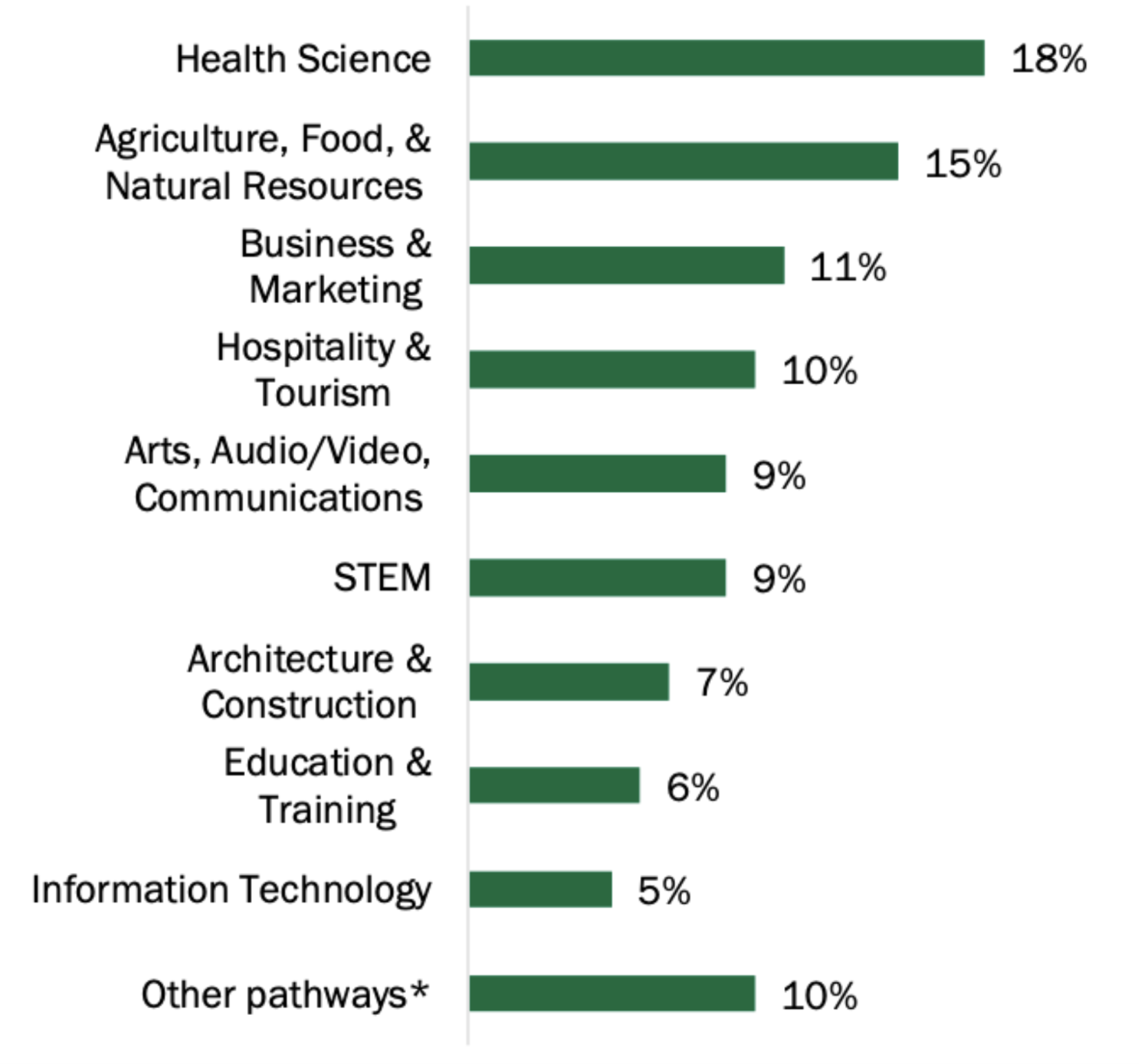
That mismatch isn’t essentially a failure. For some scholars, the flawed trail was once clarifying.
“When the scholars talked to us about it, they truly thought to be it treasured to be informed one thing they didn’t like,” mentioned Sandra Staklis, lead writer of the RTI record. “One scholar advised us, ‘Oh, my mother and my aunt are nurses. And so I attempted it out. And it became out it wasn’t for me, nevertheless it was once excellent to understand that.’”
Scholars additionally mentioned gaining a broader set of abilities which might be helpful in any box. “Scholars mentioned they had been studying the ones place of job abilities like time control and dealing with folks on a mission,” mentioned Staklis. “Numerous instructional paintings historically has been extra particular person, like studying a ebook or taking a check.”
Nonetheless, the findings carry a elementary query: Are pathways supposed to influence scholars into explicit occupation fields, or assist them determine what they don’t need to do?
Scholars additionally described how a lot they valued the mentoring they won from their instructors, lots of whom didn’t spend their skilled lives in faculties however in business. One scholar profiled within the record, Kwame, mentioned his academics within the healthcare box confirmed him find out how to ruin down dense scientific subject material and so he may just learn about to earn his paramedic certification. He’s now majoring in public well being at a four-year university and hopes to turn out to be a surgeon.
Two classes stood out from the Delaware learn about.
- Place of work enjoy issues maximum however is toughest for faculties to ship. Scholars who participated in internships or apprenticeships had been much more likely to proceed of their box, the record discovered. Any other scholar named James, additionally profiled within the record, pursued an schooling pathway in highschool and, right through his senior 12 months, he shadowed a instructor, which taught him so much about managing school room habits. He’s now pursuing an affiliate level in basic schooling.
However those alternatives are tricky for faculties to offer, requiring coordination with employers in addition to answers for scheduling and transportation.
Place of work studying was once extra commonplace in vocational excessive faculties, the place scholars regularly entire core coursework previous and will spend extra time outdoor the development right through their senior 12 months. Against this, one-time stories — equivalent to visitor audio system or box journeys — had much less have an effect on however had been more uncomplicated for faculties to organize.
- Scholars want higher steerage particularly once they need to alternate route. As soon as scholars get started a pathway, it may be tricky to change. “When you’re a junior and you wish to have to change to another pathway, you’d have to return taking categories which might be most commonly learners and sophomores, and it simply turns into logistically tricky to permit that,” mentioned Staklis.
Luke Rhine, vp for postsecondary luck at Rodel, which commissioned the research, mentioned the findings had been encouraging however level to a necessity for more potent advising, which he calls “navigational give a boost to.”
The record additionally issues to extra questions for long run analysis.
It’s unclear how a lot of the upper college-going fee will also be attributed to pathways themselves. The learn about isn’t causal, Staklis mentioned, and scholars who entire those sequences might have already got been much more likely to pursue additional schooling. Different incentives to pursue upper schooling is also enjoying a task, together with Delaware’s beneficiant scholarship techniques, which quilt tuition at Delaware Technical Neighborhood Faculty and Delaware State College for plenty of scholars.
Whilst a majority of scholars had been running, maximum had been in part-time jobs in retail, supply or fast-food that have compatibility in with their research. Longer-term results — together with careers and profits — stay unknown.
Some researchers query the construction of the pathways fashion in a swiftly converting financial system. Kerry McKittrick, co-director of the Venture on Group of workers at Harvard College, issued a record final week, “Pivots Without Pathways: Career Navigation in a Fragmented Labor Market,” according to an research of neighborhood university scholars and younger adults. McKittrick argues that it will no longer make sense to require younger scholars to move via a chain of technical coaching categories for jobs that would possibly not exist in 5 years.
“Pathways are an impressive choice, however this linear trail to a occupation is truly the exception,” mentioned McKittrick.”In an international the place jobs proceed to switch, we additionally wish to equip scholars and employees with the abilities they want. … I’m speaking about adaptability and resolution making and knowledge literacy and networking.”
The ones abilities, argues McKittrick, aren’t discovered in a school room, however via trial and blunder. What’s maximum essential, in keeping with McKittrick, is for younger other people to find a way to discover professions past what adults of their circle of relatives do and to expand networks.
Particularly, she concurs with one of the crucial Delaware record’s central findings: Place of work enjoy is also probably the most treasured element of a pathways program.


