

Deploying and managing packages could be a complicated and time-consuming activity, involving infrastructure setup, configuration, tracking, and scaling.
AWS Elastic Beanstalk simplifies this procedure by way of providing an absolutely controlled carrier that automates the deployment and scaling of cross platform app development and services.
This weblog will discover how Elastic Beanstalk works, its advantages, and a step by step information to deploying your first software.
What’s AWS Elastic Beanstalk?
AWS Elastic Beanstalk is a Platform as a Carrier (PaaS) resolution that allows builders to deploy and arrange packages within the AWS cloud with out being concerned concerning the underlying infrastructure.
It helps quite a lot of programming languages and frameworks, together with:
- Java
- .NET
- js
- Python
- Ruby
- Cross
- PHP
With Elastic Beanstalk, you merely add your software code, and the carrier handles the remaining: provisioning assets, load balancing, scaling, tracking, and health checks.
Key Options of Elastic Beanstalk
- Simplified Deployment: Temporarily deploy packages with out managing servers or configurations.
- Automated Scaling: Elastic Beanstalk routinely adjusts the collection of circumstances in response to site visitors.
- Tracking and Logging: Built-in with CloudWatch for efficiency tracking and log get entry to.
- Customizability: Customise the surroundings by way of importing configuration information or integrating with different AWS services and products.
- Multi-Surroundings Fortify: Simply arrange more than one environments (e.g., pass platform app building, staging, manufacturing).
Advantages of The usage of Elastic Beanstalk
- Ease of Use: Simplifies the deployment procedure, permitting builders to concentrate on writing code.
- Value-Efficient: Pay just for the AWS assets your software consumes.
- Flexibility: Make a selection your most popular language, framework, and deployment fashion.
- Scalability: Mechanically scales your software to deal with larger site visitors.
- Built-in Control: Track and arrange packages by the use of the AWS Management Console, CLI, or APIs.
Use Instances of Elastic Beanstalk
- Internet Software Web hosting: Host and run internet packages with out the want to configure servers.
- Steady Integration/Steady Deployment (CI/CD): Combine with pipelines easily for streamlined pass platform app building and deployment processes.
- E-commerce Platforms: Scale your on-line store to deal with variable site visitors so much.
- API Web hosting: Host RESTful APIs with fault tolerance and top availability.
- MVP Construction: Impulsively deploy minimal viable merchandise (MVPs) to gauge marketplace readiness.
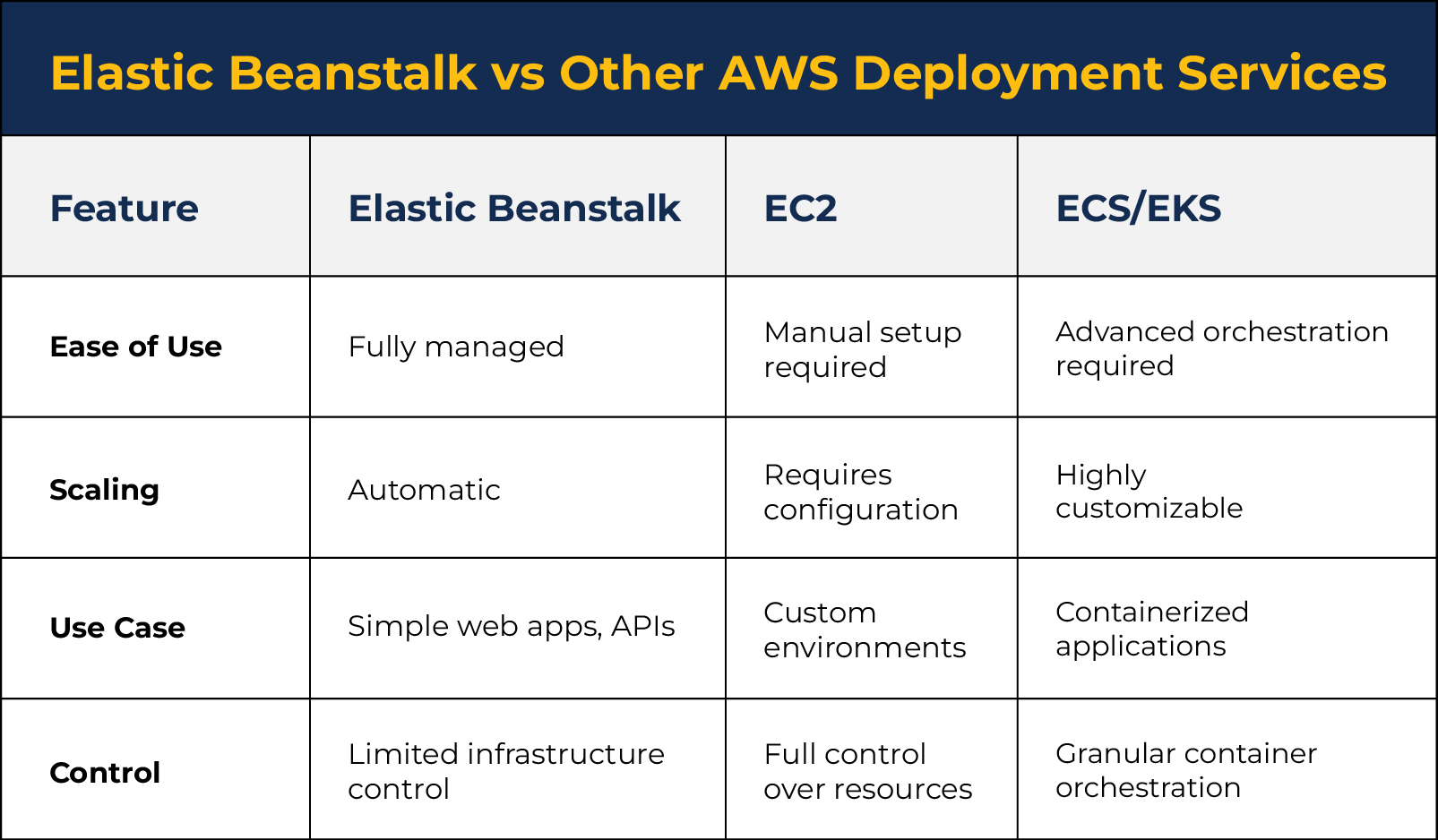
Necessities
Sooner than deploying an software with Elastic Beanstalk, be sure to have the next:
- An AWS account.
- AWS CLI put in and configured.
- A fundamental figuring out of your software’s code and framework.
Getting Began with Elastic Beanstalk
Step 1: Get ready Your Software
- Package deal your software information in line with your language or framework necessities. For instance, a Python software would generally have a necessities.txt document and a first-rate software document reminiscent of app.py.
- Be sure your software runs in the neighborhood earlier than deploying it to Elastic Beanstalk.
Step 2: Create an Elastic Beanstalk Software
- Log in to the AWS Control Console.
- Navigate to Elastic Beanstalk.
- Click on Create Software.
- Supply a reputation to your software (e.g., MyFirstApp).
- Make a choice the platform that fits your software (e.g., Node.js, Python, and so on.).
- Add your software code as a ZIP document.
- Click on Create Software.
Elastic Beanstalk will routinely provision the vital assets, together with EC2 circumstances, load balancers, and a default safety crew.
Step 3: Configure Your Surroundings
- As soon as your software is deployed, you’ll be able to configure the surroundings to fit your wishes:
- Scaling: Alter the auto-scaling settings to deal with various ranges of site visitors.
- Surroundings Variables: Upload key-value pairs to configure your software.
- Example Sorts: Make a choice the precise EC2 example sort for efficiency and value optimization.
2. Click on Save to use your adjustments.
Step 4: Track and Arrange Your Software
Elastic Beanstalk integrates seamlessly with CloudWatch, enabling you to observe:
Get admission to those metrics during the Elastic Beanstalk dashboard or CloudWatch console.
Step 5: Replace Your Software
To deploy new variations of your software:
- Navigate in your software within the Elastic Beanstalk console.
- Click on Add and Deploy.
- Make a choice your up to date ZIP document and deploy it.
Elastic Beanstalk handles the replace procedure, making sure minimum downtime.
Safety Issues
- IAM Roles: Make certain that best vital permissions are granted to Elastic Beanstalk assets.
- HTTPS: Configure your surroundings to serve site visitors over HTTPS.
- Backup and Restoration: Steadily again up your information and configurations.
Conclusion
AWS Elastic Beanstalk is a formidable instrument that simplifies software deployment and control, making it preferrred for builders who need to focal point on development options relatively than managing infrastructure.
Through following this information, you’ll be able to briefly deploy and arrange scalable, protected, and dependable packages. Whether or not you’re a seasoned developer of pass platform app building or simply beginning, Elastic Beanstalk can streamline your deployment workflow.
If you wish to have additional lend a hand, you’ll be able to touch us at [email protected]. We can agenda a loose session consultation to discover how Xavor can help you on this subject.


