

The instructor didn’t reply, and docked Ostovitz’s grade.
Ostovitz’s mother, Stephanie Rizk, says her daughter is a high-achieving pupil who cares about doing neatly at school and she or he was once alarmed when the trainer jumped to conclusions about Ostovitz’s paintings so early within the faculty yr.
“Get to grasp their degree of ability, after which possibly your AI detector comes in handy,” Rizk says.
Rizk informed NPR she met with the trainer in mid-November and the trainer stated they by no means noticed her daughter’s message.
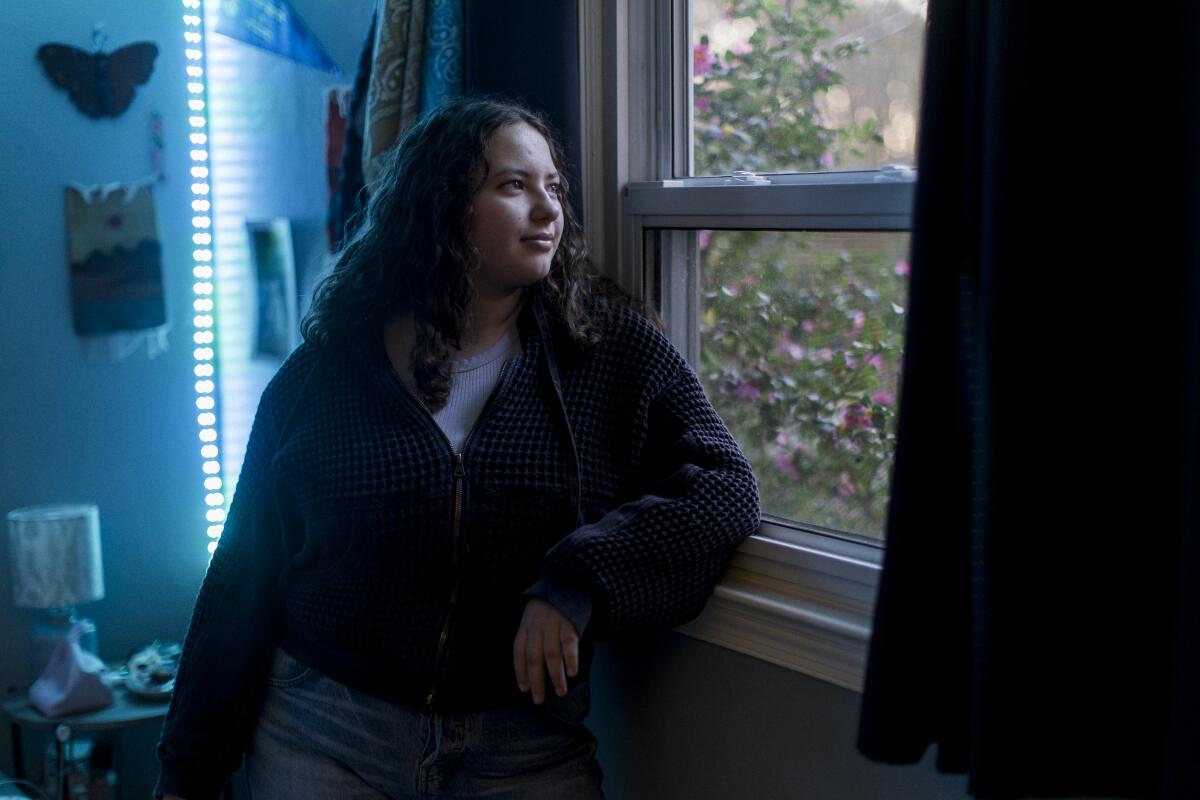
The college district, Prince George’s County Public Colleges, made transparent in a observation that Ostovitz’s instructor used an AI detection device on their very own and that the district doesn’t pay for this instrument.
“Right through body of workers coaching, we recommend educators to not depend on such equipment, as more than one resources have documented their attainable inaccuracies and inconsistencies,” the observation stated.
PGCPS declined to make Ostovitz’s instructor to be had for an interview. Rizk informed NPR that when their assembly, the trainer now not believed Ostovitz used AI.
However what came about to Ostovitz isn’t sudden.
Greater than 40% of surveyed Sixth- to Twelfth-grade lecturers used AI detection equipment throughout the closing faculty yr, consistent with a nationally representative poll via the Middle for Democracy and Generation, a nonprofit that advocates for civil rights and civil liberties within the virtual age.
That’s in spite of numerous research studies appearing that AI detection equipment are a long way from dependable.
“It’s now reasonably neatly established within the educational integrity box that those equipment don’t seem to be are compatible for goal,” says Mike Perkins, a number one researcher on educational integrity and AI at British College Vietnam.
Perkins discovered that one of the most hottest AI detectors — together with Turnitin, GPTZero and Copyleaks — flagged some issues as AI that weren’t, and vice versa. Their accuracy charges dropped even additional when AI textual content was once manipulated to seem extra human.
“We noticed some truly relating to issues of one of the most maximum prolific AI textual content detection equipment,” he says.
Regardless of the ones issues, NPR discovered that college districts from Utah to Ohio to Alabama are spending hundreds of bucks on those equipment.
Why one of the vital country’s biggest districts makes use of AI detection instrument
Close to Miami, Broward County Public Colleges is spending greater than $550,000 on a three-year contract with Turnitin. The long-standing ed-tech corporate has traditionally supplied faculties with plagiarism detection instrument; in 2023, it presented an AI detection characteristic. When educators put pupil paintings via this device, it generates a proportion, which displays the quantity of textual content the instrument determines was once most probably generated via AI. One caveat: According to the company, rankings of 20% or decrease are much less dependable.
“The Turnitin device is one thing that is helping us facilitate dialog and comments, now not grading,” says Sherri Wilson, director of cutting edge studying for the Broward faculty district, which enrolls greater than 230,000 scholars and is without doubt one of the biggest faculty districts within the nation.
Wilson says the district is “completely mindful” of the analysis appearing AI detection equipment, together with Turnitin, aren’t 100% correct or dependable.
Turnitin additionally recognizes this: On the company’s website, it says, “our AI writing detection would possibly not all the time be correct … so it will have to now not be used as the only real foundation for opposed movements towards a pupil.”
Turnitin wrote in a observation to NPR that it’s extra vital to steer clear of falsely accusing scholars of dishonest than to catch all AI writing.
Wilson says the Turnitin device remains to be treasured as it saves lecturers time via temporarily scanning pupil paintings for suspected AI use.
One more reason that Broward lecturers have get admission to to the device, Wilson says, is that the district participates in educational systems, reminiscent of World Baccalaureate, or IB, during which pupil paintings will have to be authenticated via lecturers ahead of it’s despatched out for exterior overview.
Either one of the systems Broward gives, IB and World Schooling at Cambridge, informed NPR that colleges don’t seem to be required to make use of AI detection instrument as a part of the authentication procedure. However, Broward informed NPR in a observation, “we have now selected to supply our lecturers with [Turnitin] as one of the vital equipment to fulfill the necessities.”
However Wilson says lecturers are without equal authority on whether or not a pupil’s paintings is their very own — now not the AI detection device.
“They’re the use of those equipment as comments to then have the ones teachable moments with scholars,” she says.
Why one instructor makes use of AI detection equipment
Language and literature instructor John Grady says, for him, AI detection equipment supply “a leaping off level” to begin a dialog with a pupil who will have used AI.
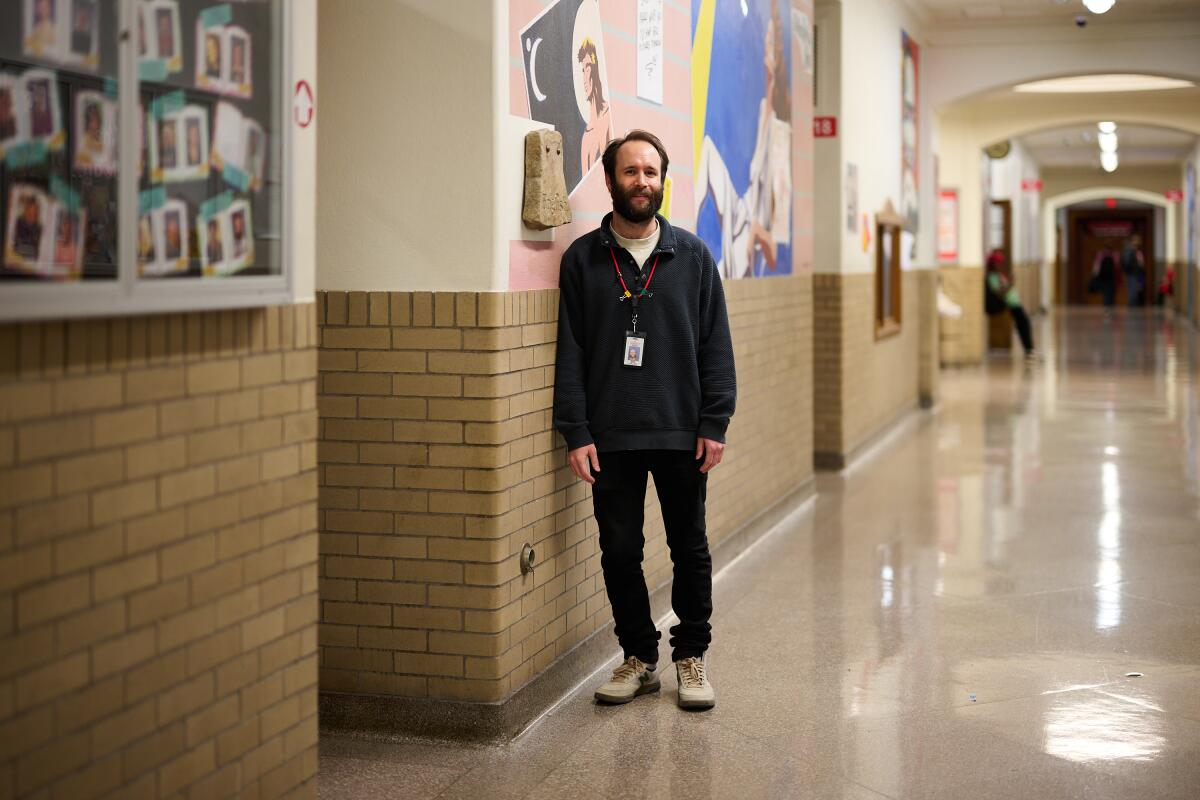
“It’s under no circumstances foolproof,” he says. “But it surely will give you one thing to hold your hat on.”
Grady teaches at Shaker Heights Top College, a part of the Shaker Heights Town College District out of doors Cleveland. The district serves more or less 4,400 scholars, and is paying GPTZero, some other AI detection instrument corporate, about $5,600 this yr for annual licenses for 27 of the district’s lecturers. The device calculates a proportion chance {that a} pupil’s paintings is AI-generated.
Grady says he places all pupil essays via GPTZero; if the device presentations greater than a 50% chance AI was once used for the task, Grady digs deeper. That incorporates the use of revision historical past equipment to peer how a lot time a pupil spent on an task, and what number of edits they made throughout the writing procedure. If it seems that {that a} pupil made just a few edits and spent infrequently any time writing, he’ll take a look at in with that pupil.
“And I’ll say, ‘Hello, this flagged. Are you able to communicate to me about why?’ I’d say the majority of the time, like 75%, if it was once AI, they’d be like, ‘Yeah, I did.’ And I’m like, ‘OK, neatly now you’ve were given to rewrite it with much less credit score,’” Grady says.
Edward Tian, co-founder and CEO of GPTZero, says that is how educators will have to be the use of his corporate’s device.
“We for sure don’t imagine this can be a punishment device,” Tian says. “This must be a device within the toolkit and now not the overall smoking gun.”
He says it’s vital to take into account that a GPTZero likelihood rating below 50% approach it’s much more likely the textual content was once human as opposed to AI-generated. He says rankings over 50% warrant nearer exam — like what Grady describes.
Tian doesn’t dispute the analysis that presentations GPTZero isn’t all the time dependable. However he notes that there are educators, like Grady, who nonetheless in finding it treasured for the tips it supplies.
He says that equipment like his be offering a “sign on what’s going down on your study room” however that lecturers will have to all the time observe up with scholars if that sign presentations one thing relating to.
The AI detection skeptics
Shaker Heights junior Zi Shi, whose first language is Mandarin, says his writing taste can now and again appear to be AI “on account of the repetition of phrases I exploit. I believe adore it’s on account of how restricted my vocabulary is.”
Shi — who isn’t a pupil of Grady’s — says he’s nonetheless operating on his writing talents and he’s involved that AI detection instrument may well be biased towards non-native English audio system like himself.
Some educators proportion this fear, although the analysis thus far is restricted and contradictory.
Shi says an task he finished for his English magnificence previous this autumn was once flagged via GPTZero as most likely AI-generated. He says his instructor instructed that his use of a web-based device referred to as Grammarly will have induced the detection instrument. Grammarly makes use of AI to proper grammar and, if triggered, generate textual content. (The instructor showed Shi’s account with NPR.)
Shi says he simplest used Grammarly to wash up his writing and that he wrote the task himself. “It was once for sure disappointing to peer the remark of it being flagged as AI,” Shi says.
Shi thinks AI detectors will have to be considered a “smoke alarm, the place it’s an indication, or caution. However, , now and again it may well be like a false alarm.”
He questions whether or not the college district will have to be spending hundreds of bucks on AI detection instrument. He says that cash may well be higher spent on skilled building for lecturers.
Carrie Cofer, a highschool English instructor within the Cleveland Metropolitan College District — only some miles from Shaker Heights — stocks that view.
Closing yr, as an experiment, she uploaded a bankruptcy of her Ph.D. dissertation into GPTZero. “And it got here up with like 89% or 91% AI-written, and I’m like, ‘Oh, no, I don’t assume that’s proper, as it was once all mine,’” Cofer says.

Cofer helps her district form its AI coverage and tips; she says Cleveland faculties don’t recently pay for AI detection instrument and she or he’d suggest towards it.
“I don’t assume it’s an efficacious use in their cash,” Cofer says. “The youngsters are going to get round it by hook or by crook.”
Some workarounds that scholars may just flip to incorporate the use of AI detection instrument themselves, to workshop assignments in order that they don’t get flagged, and the use of “AI humanizer” programs, which declare to make AI-generated writing seem extra human.
In the long run, she says, lecturers will wish to adapt to AI via converting how they train and assess pupil studying.
Again in Maryland, highschool junior Ailsa Ostovitz could also be adapting. She now runs all her homework assignments via more than one AI detection equipment ahead of she turns them in.
The writing is her personal, she says, however she’ll rewrite sentences the instrument identifies as most likely AI-generated, an additional step that provides about part an hour to each and every task.
“I feel I’ve for sure change into extra vigilant about presenting my paintings as mine and now not AI,” she explains.
She doesn’t need to take any possibilities.
This reporting was once supported via a grant from the Tarbell Center for AI Journalism.


