

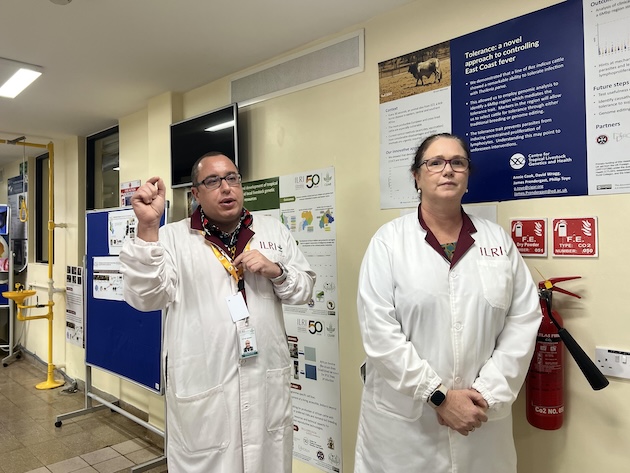
NAIROBI, Apr 22 (IPS) – Cattle are a lifeline for thousands and thousands of farmers in Africa as a supply of meals and wealth. However devastating illnesses are threatening the well being and productiveness in their animals.
Now scientists on the World Cattle Analysis Institute (ILRI) have unleashed a toolbox of science answers by way of outsmarting the parasites and pathogens that value thousands and thousands of greenbacks in cattle losses throughout Africa. The toolbox contains the whole lot from vaccines that offer protection to cattle from ‘livestock malaria’ to genetics to reproduce animals tolerant to East Coast fever.
East Coast fever is wiping out livestock herds throughout Africa, triggering revenue losses and meals lack of confidence. Transmitted by way of ticks, East Coast fever (ECF) kills over 1,000,000 livestock every 12 months, with younger calves particularly in peril, says Dr. Nicholas Svitek, a microbiologist and senior scientist at ILRI’s Well being Program and Centre for Tropical Cattle Genetics and Well being (CTLGH).
Led to by way of a parasite known as Theileria parva, ECF can also be likened to the livestock model of malaria. It’s brought about by way of a parasite carefully associated with the person who impacts people, Plasmodium sp.
“ECF claims the lives of a couple of million livestock yearly—about one head of livestock each thirty seconds,” mentioned Svitek, including that the illness reasons greater than US$500 million in financial losses once a year.
Science to the Rescue
Thru a strategic partnership between the Roslin Institute, Scotland Rural School, and ILRI, CTLGH is creating genetic answers to make stronger livestock-based livelihoods by way of finding out the resistance of African indigenous livestock to ECF.
Svitek mentioned scientists have known a genetic marker, this is, a particular mutation in a gene known as FAF1B related to resistance to the ECF-causing parasite.
“We’re these days finding out the mechanism to substantiate what the function of this gene is within the resistance to the illness,” mentioned Svitek. “This find out about is relatively a step forward now not simplest to grasp the biology of the parasite however, most significantly, how we will use this data for breeding systems to make a choice animals that experience this genetic marker so we will breed them, so by way of deciding on those animals we will make stronger the well being and total productiveness of the animals.”
ILRI has created experimental vaccines the use of synthetic intelligence and genetically changed viruses to assist livestock construct immunity towards the Theileria parva parasite.
The Institute has additionally evolved experimental vaccines towards the bacterial pathogen inflicting Contagious Caprine Pleuropneumonia (CCPP), Mycoplasma capricolum, a extremely contagious respiration illness in goats and the bacterial pathogen inflicting Contagious Bovine Pleuropneumonia (CBPP), Mycoplasma mycoides, which impacts livestock.
Svitek and Dr. Hussein Abkallo, a molecular biology scientist, were a part of the groundbreaking use of the CRISPR-Cas era to genetically engineer the African swine fever virus the use of weakened viruses as a vaccination technique. CRISPR-Cas is the “genetic scissors” scientists use to edit DNA—the instruction guide inside of each dwelling mobile—that reasons illness.
Wholesome Herds, Satisfied Farmers
ILRI’s science answers will lead to greater animal productiveness because of higher well being and less deaths. But even so, scientists at the moment are in a position to raised display screen livestock which can be extra resilient to commonplace infections whilst decreasing the reliance on pricey antibiotics in treating ill animals.
Dr. Anna Lacasta, a senior scientist at ILRI specializing in animal well being, mentioned they’re creating efficient vaccines for creating nations. Dr. Svitek and his crew have evolved the primary fast check prototype the use of the CRISPR-Cas era for diagnosing ECF within the box.

“ECF reasons malaria however for livestock so this is a difficult illness to broaden a vaccine for, as it’s for malaria in folks,” mentioned Lacasta, who has led the vaccine building analysis on East Coast fever and African swine fever (ASF)—two essential cattle illnesses these days endemic in low- and middle-income nations.
ASF is a devastating illness affecting pig manufacturing in creating nations; present keep watch over strategies, comparable to culling affected animals and the use of biosecurity in containing the illness, are insufficient.
ILRI has evolved reside attenuated vaccines (LAV) for ASF genotypes circulating in East Africa with promising effects.
Analysis is ongoing at the Contagious Caprine Pleuropneumonia (CCPP), a serious, extremely contagious mycoplasmal respiration illness essentially affecting goats and sheep, as is the Contagious Bovine Pleuropneumonia (CBPP) in livestock.
“Illnesses comparable to CCPP and CBPP are thought to be omitted as a result of they have an effect on animals in Africa. The illnesses have been eliminated in Europe, The usa, and Australia, however we nonetheless have the CCPP in Asia and CBPP in Africa,” mentioned Dr. Elise Schieck, a senior scientist at ILRI, noting that the other vaccines have been being evaluated for effectiveness.
Regardless of the advance and use of quite a lot of science answers to tackling cattle illnesses, there are obstacles to their good fortune. Get entry to to vaccines and diagnostic equipment is a problem for farmers throughout Africa, particularly the place chilly garage amenities are had to stay the vaccines. But even so, restricted extension and advisory services and products have additionally hindered farmers from taking on the inventions.
With the correct partnerships and insurance policies, science-led cattle well being inventions can spice up agricultural enlargement in Africa.
IPS UN Bureau Record
Follow @IPSNewsUNBureau
Follow IPS News UN Bureau on Instagram
© Inter Press Carrier (2025) — All Rights Reserved. Original source: Inter Press Service


