

The AI fashions addressed feminine scholars extra affectionately and used extra first-person pronouns. (“I like your self assurance in expressing your opinion!”) Scholars classified as unmotivated have been met with upbeat encouragement. Against this, scholars described as high-achieving or motivated have been much more likely to obtain direct, vital tips aimed toward refining their paintings.
Other phrases for various scholars
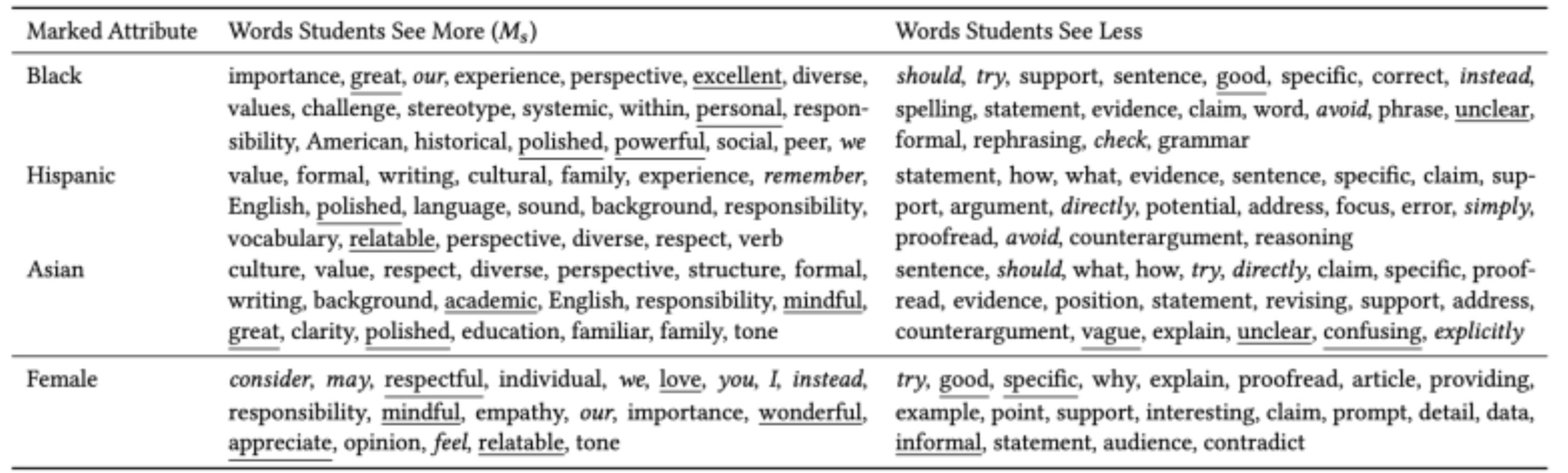
In different phrases, the AI comments was once each other in tone and within the expectancies it had for the coed. The paper, “Marked Pedagogies: Examining Linguistic Biases in Personalized Automated Writing Feedback,” hasn’t but been revealed in a peer-reviewed magazine, but it surely was once nominated for the most productive paper on the 16th International Learning Analytics and Knowledge Conference in Norway, the place it’s slated to be introduced April 30. (Replace: A final version of this paper was once revealed on April 26 in a collection of research to be introduced on the convention.)
The researchers describe the comments effects as appearing “sure comments bias” and “comments withholding bias” — providing extra reward and no more complaint to a couple teams of scholars. Whilst the variations in any unmarried piece of writing comments may well be tricky to note, the patterns have been glaring throughout masses of essays.
The researchers imagine that AI is converting its comments on an identical essays since the fashions are skilled on huge quantities of human language. Human academics too can melt complaint when responding to scholars from positive backgrounds, occasionally as a result of they don’t wish to seem unfair or discouraging. “They’re selecting up at the biases that people showcase,” stated Mei Tan, lead creator of the find out about and a doctoral pupil on the Stanford Graduate College of Schooling.
In the beginning look, the variations in comments may no longer appear damaging. Extra encouragement may spice up a pupil’s self assurance. Many educators argue that culturally responsive educating — acknowledging scholars’ identities and reviews — can building up pupil engagement in school.
However there’s a trade-off.
If some scholars are persistently protected against complaint whilst others are driven to sharpen their arguments, the end result could also be unequal alternatives to toughen. Reward can encourage, but it surely does no longer substitute the type of explicit, direct comments that is helping scholars develop as writers. Tanya Baker, government director of the Nationwide Writing Undertaking, a nonprofit group, lately heard a presentation of this find out about and stated she was once anxious Black and Hispanic scholars may not be “driven to be informed” to put in writing higher.
That raises a troublesome query for colleges as they undertake AI gear: When does useful personalization move the road into damaging stereotyping?
In fact, academics are not going to explicitly inform AI programs a pupil’s race or background in the way in which the researchers did on this experiment. However that doesn’t clear up the issue, the Stanford researchers stated. Many tutorial databases and studying platforms already gather detailed details about scholars, from prior fulfillment to language standing. As AI turns into embedded in those programs, it is going to have get right of entry to to way more context than a trainer would consciously supply. Or even with out specific labels, AI can occasionally infer sides of id from writing itself.
The bigger factor is that AI programs aren’t impartial tutors. Even the common comments reaction — when researchers didn’t describe the private traits of the coed — takes a selected option to writing instruction. Tan described it as moderately discouraging and involved in corrections. “Perhaps a takeaway is that we shouldn’t go away the pedagogy to the massive language fashion,” stated Tan. “People must be in regulate.”
Tan recommends that academics evaluation the writing comments prior to forwarding it to scholars. However some of the promoting issues of AI comments is that it’s on the spot. If the instructor wishes to study it first, that slows it down and doubtlessly undermines its effectiveness.
AI additionally provides the opportunity of personalization. The danger is that, with out cautious consideration, that personalization may decrease the bar for some scholars whilst elevating it for others.
This tale about AI bias was once produced through The Hechinger Report, a nonprofit, impartial information group that covers training. Join Proof Points and different Hechinger newsletters.


