

For just about a decade, mobile development services had been break up into two deeply entrenched camps. First, are the natural local purists writing Swift and Kotlin, and 2d, the cross-platform pragmatists depending on React Local. However if you happen to take a look at the cellular panorama in 2026, that dividing line has utterly vanished.
React Local is now not only a framework for spinning up fast MVPs. It’s the venture usual, closely followed by means of tech giants like Meta, Microsoft, and Shopify. On the absolute middle of this revolution is Expo.
As soon as regarded as only a beginner-friendly wrapper, Expo has matured into the definitive toolchain for React Local building. Recall to mind it because the Subsequent.js of the cellular global. With the rollout of Expo SDK 54 and the extremely expected SDK 55, the ecosystem is present process an enormous architectural shift.
If you’re development cellular apps this 12 months, listed here are the 5 main Expo framework tendencies and lines you want to learn about.
The demise of the bridge: The new structure is necessary
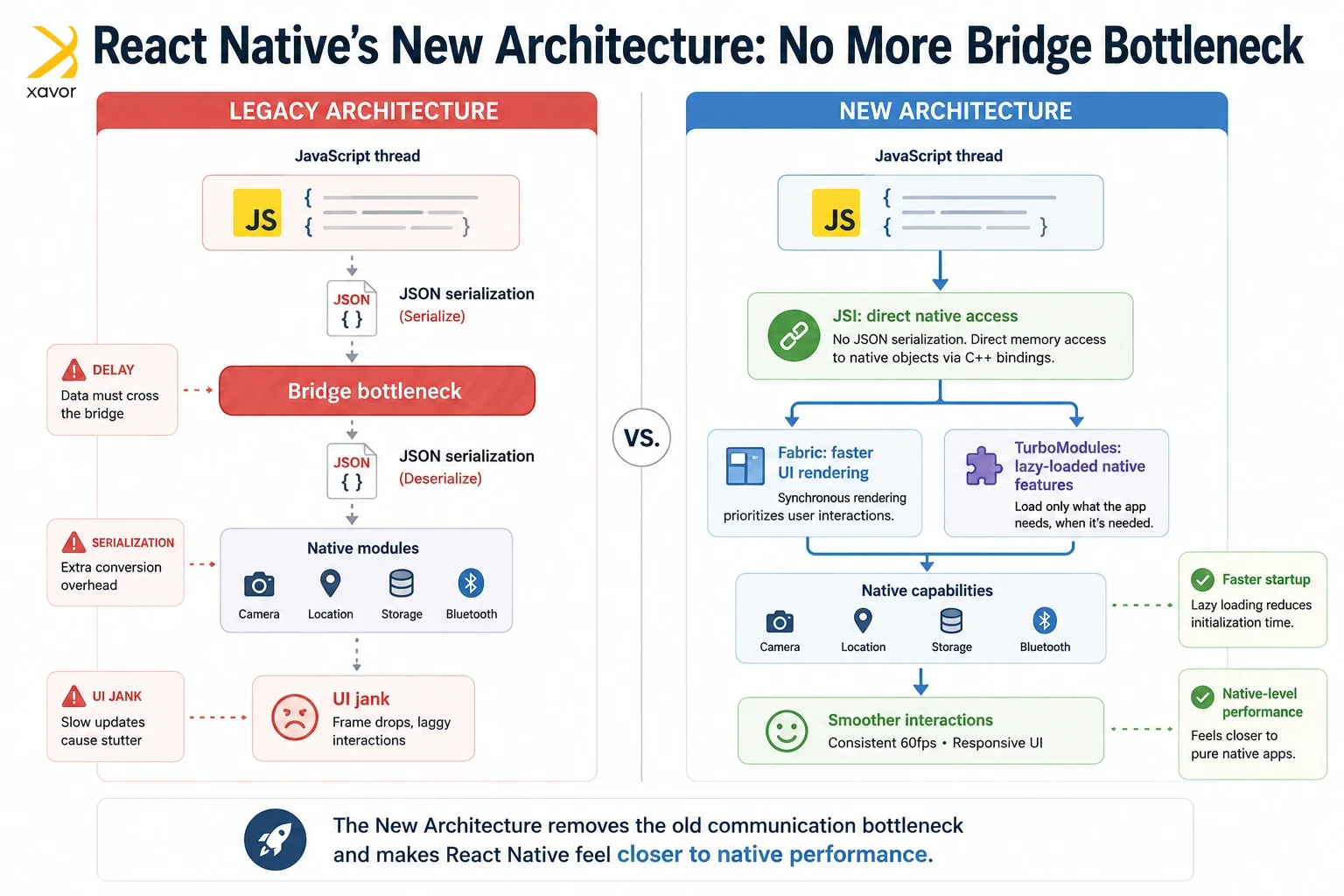
If in case you have been soaring across the React Local ecosystem for some time, you’ve got certainly heard about the “New Structure.” For years, it used to be an experimental opt-in characteristic. In 2026, with Expo SDK 55 and React Local 0.83, the Legacy Structure is formally lifeless and got rid of from the codebase. The new structure is now necessary.
Why is that this this kind of huge deal for Expo builders?
Traditionally, React Local depended on a “Bridge” to keep up a correspondence between the JavaScript thread and the local software {hardware}. Communique on this approach required records to be serialized into JSON to be despatched around the bridge with deserialization. For heavy animations or complicated lists, this brought about a infamous UI stutter referred to as “jank.”
The New Structure fixes this utterly via 3 core upgrades:
- JSI (JavaScript Interface): Lets in JavaScript to carry direct references to C++ local gadgets. Not more JSON serialization.
- Material Renderer: A rewritten UI layer that updates synchronously with the host platform (iOS/Android), prioritizing pressing UI interactions like swipe gestures over background duties.
- TurboModules: Local modules are actually lazy-loaded, which means your app best initializes the particular software options (just like the digital camera or GPS) precisely when the person wishes them, slashing startup instances.
Subsequently, Expo guarantees that each and every new app in-built 2026 begins with baseline functionality this is just about indistinguishable from a natural local app via forcing the brand new structure because the default
Hermes v1 and the magic of bytecode diffing
Over-the-Air (OTA) updates are arguably Expo’s superpower. Via Expo Software Services and products (EAS), builders can push worm fixes and minor characteristic updates without delay to customers’ units with out looking ahead to Apple or Google to check the app of their respective shops.
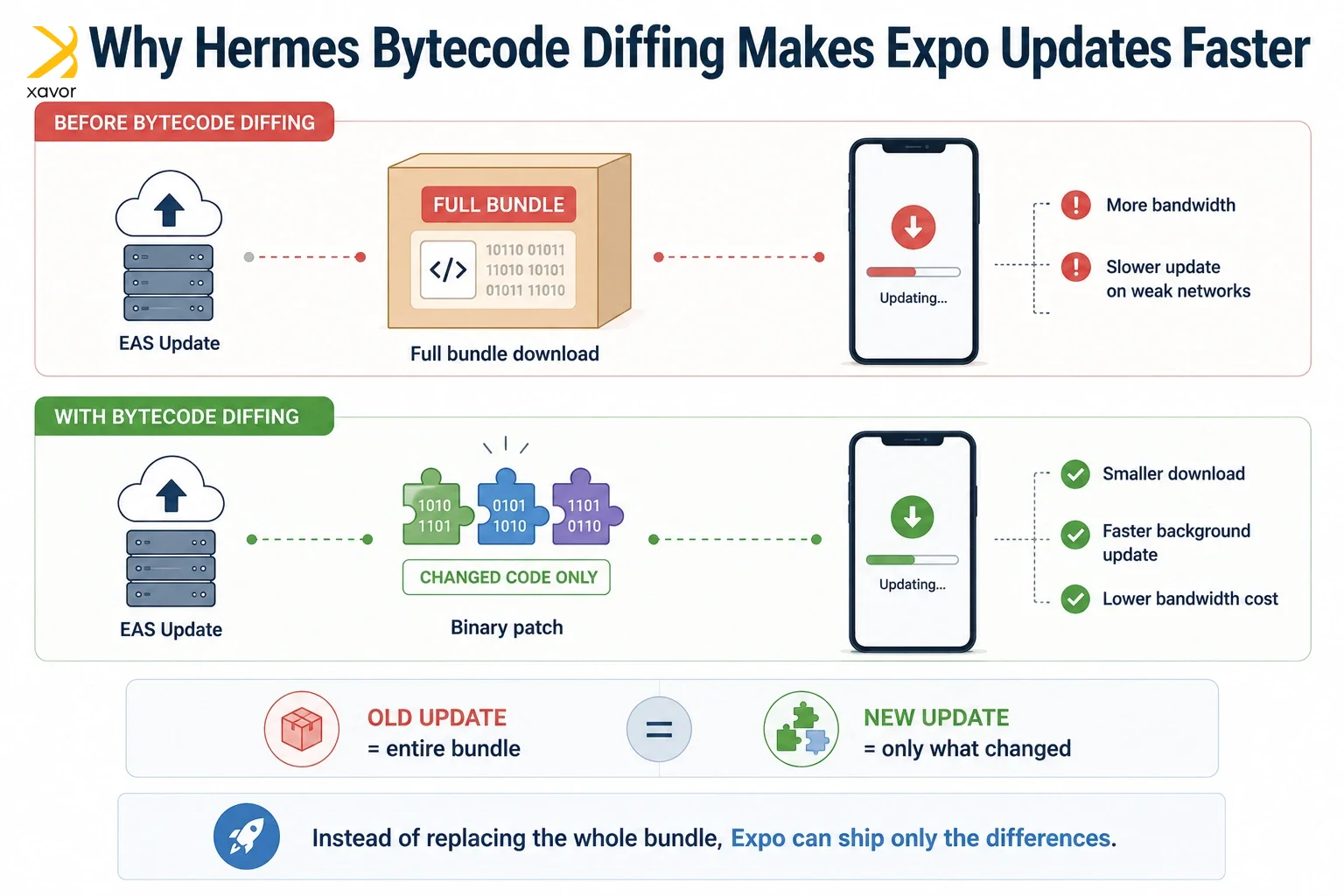
With the most recent SDKs, Expo has supercharged this procedure by means of totally embracing Hermes v1, Meta’s mobile-optimized JavaScript engine. However the actual game-changer in 2026 is Hermes bytecode diffing.
In the past, while you driven an OTA replace, the person’s software needed to obtain all of the new JavaScript package deal. Whilst small, this would nonetheless devour up bandwidth and decelerate the replace procedure on deficient mobile connections.
Bytecode diffing adjustments the maths totally. Now, EAS Replace best sends the binary patches—the literal variations between the outdated code and the brand new code.
- 75% Smaller Updates: Replace sizes are actually a fragment in their earlier weight.
- Speedy Software: Smaller information imply lightning-fast downloads, permitting updates to use nearly immediately within the background.
- Value Potency: For builders, this tremendously reduces the bandwidth ate up on EAS plans, saving cash at scale.
Expo router and the Subsequent. js-ification of cellular
Routing in React Local was a nightmare of nested navigators and extremely handbook deep-linking configurations. Then got here Expo Router, which introduced the file-based routing paradigm of cyber web frameworks (like Subsequent.js) without delay to cellular.
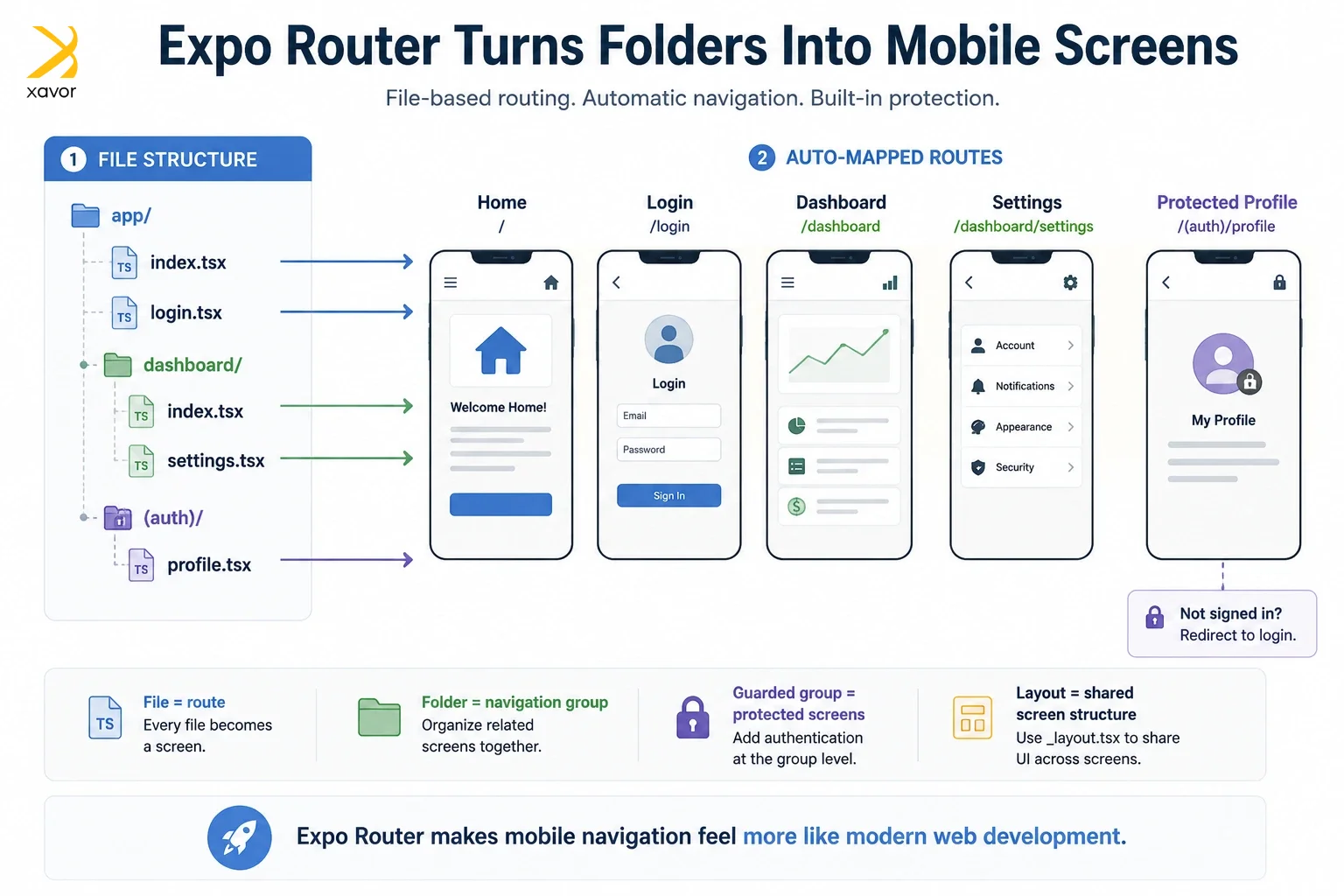
Within the best 5 Expo Framework tendencies, Expo Router simply earns its position as it isn’t only a routing library; this is a full-fledged utility framework. The most recent updates have presented options that basically trade how we construction apps:
- Experimental SplitView Improve: An extended-awaited characteristic that makes development responsive, tablet-optimized, two-pane layouts extremely easy.
- Guarded Teams: Consumer-side routes can now be grouped and secure by means of authentication guards proper on the folder point. If a person isn’t logged in, the router immediately redirects them to an anchor course with out flashing secure displays.
- Synchronous Layouts: Monitors now replace synchronously by means of default, getting rid of the ones awkward visible sparkles throughout tab transitions.
Moreover, Expo is aggressively pushing towards the long run by means of laying the groundwork for React Server Elements (RSC) on cellular. Whilst nonetheless in its early levels, RSC make stronger approach we will be able to quickly have the ability to offload heavy data-fetching and UI rendering good judgment to the server, leading to tremendously smaller app package deal sizes.
The “brownfield” revolution
A large hurdle for venture firms has at all times been the “all-or-nothing” nature of cellular frameworks. If a financial institution had an enormous iOS app written in Swift and sought after to undertake React Local, they needed to painstakingly combine it, regularly managing messy Node.js environments along Xcode.
The most recent set of Expo framework tendencies has solved this in 2026 with the creation of the expo-brownfield bundle.
“Brownfield” building refers to including new code to an present mission. With this new bundle, Expo introduces an remoted solution to integration. You’ll be able to now bundle all your React Native/Expo app as a standalone local library (an AAR for Android or an XCFramework for iOS).
Local builders can then drop this library without delay into their present Swift or Kotlin codebases. They don’t want to set up Node.js, they don’t want to run Metro bundlers, and so they don’t want to perceive React. They simply eat your Expo options like some other local dependency. This can be a huge worm for buying Expo into legacy venture apps.
EAS workflows: The final cellular CI/CD5
After all, we can’t speak about Expo in 2026 with out bringing up the evolution of EAS (Expo Software Services and products). Development cellular apps in the neighborhood is notoriously irritating because of Xcode and Android Studio dependencies. EAS moved the construct procedure to the cloud, however the most recent of all Expo framework tendencies is the shift towards EAS workflows.
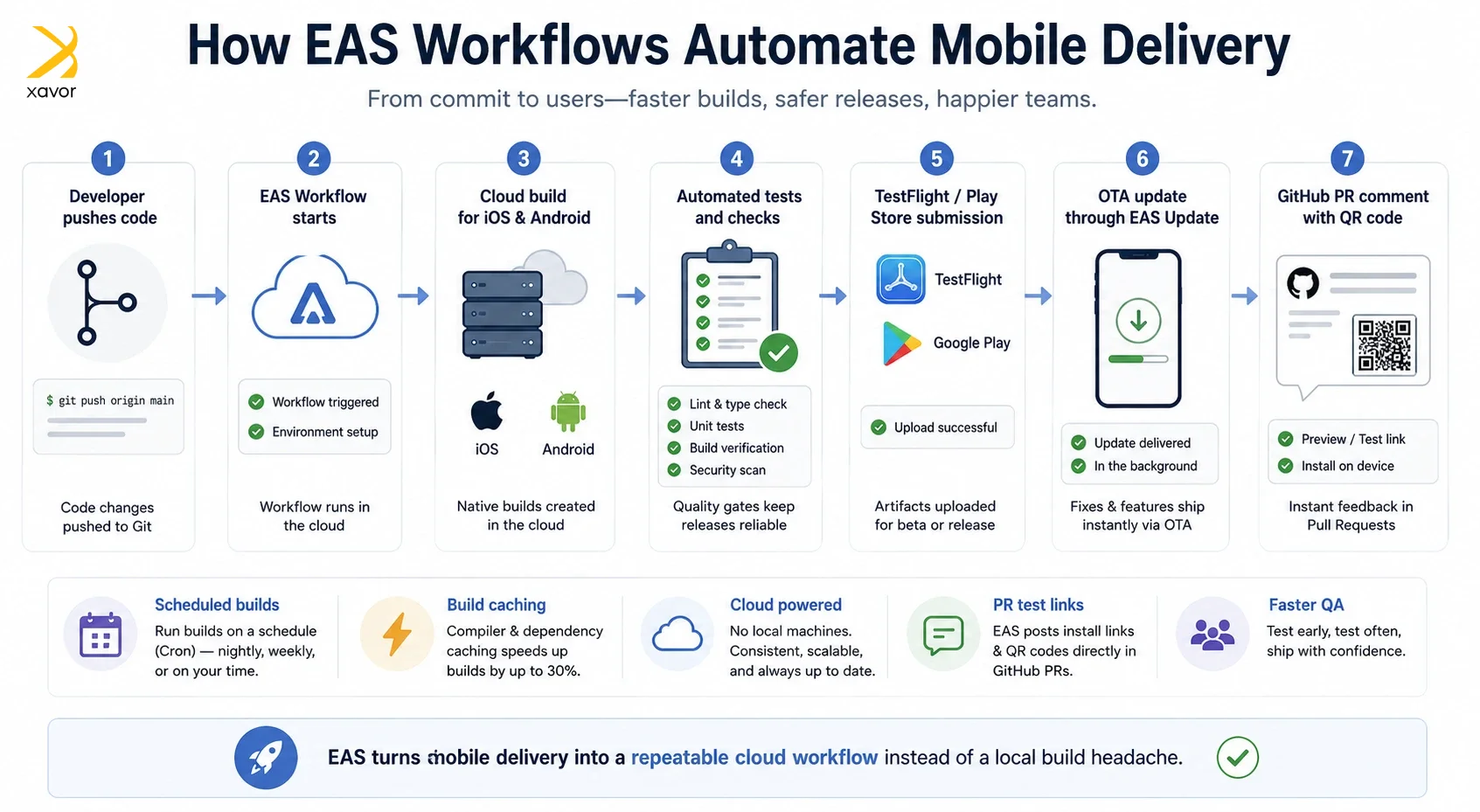
EAS Workflows have successfully changed conventional GitHub construct triggers with a hyper-tailored cellular CI/CD pipeline.
- Scheduled Cron Jobs: You’ll be able to now automate regimen duties. Need to robotically cause a manufacturing construct and put up it to Apple’s TestFlight each and every Friday at 2:00 AM? You’ll be able to do this natively in EAS.
- Compiler Caching: EAS now helps complicated construct caching, dashing up next Android and iOS builds by means of as much as 30%.
- GitHub Remark Jobs: When a workflow finishes, EAS can robotically submit a record (with QR codes for immediate checking out) without delay into your GitHub Pull Requests, making QA checking out totally frictionless.
Conclusion
The controversy over whether or not to make use of cross-platform or natural local equipment is over. In 2026, opting for Swift or Kotlin for the standard, data-driven utility is more and more observed as a untimely optimization.
With the required enforcement of the New Structure, the Subsequent.js-style building revel in of Expo Router, and the enterprise-grade deployment equipment of EAS, the Expo framework has moved up the abstraction ladder.
It lets in builders to send options at web-speed, with out sacrificing a unmarried drop of local cellular functionality. In case you aren’t development with Expo nowadays, you might be already falling in the back of.
However Xavor will let you regain tempo with knowledgeable cellular app building services and products. Our builders are talented in all main cellular building frameworks and applied sciences, together with Expo, Flutter, and extra.
Touch us at [email protected] to e book a unfastened session consultation.
In regards to the Writer

Umar is a era chief that specialize in cellular utility building, with 15+ years of revel in development scalable virtual answers. He makes a speciality of designing high-performance cellular and cyber web programs, serving to organizations ship seamless person stories via trendy applied sciences, cloud platforms, and cutting edge building practices.
FAQs
Nor is universally higher because it depends upon your mission. Expo is perfect for sooner building and integrated tooling, which is the requirement for 90% of tasks. Whilst React Local CLI gives larger flexibility and lower-level get entry to for apps with extremely custom designed local necessities.
Use Expo Opt for fast prototyping with usual Expo APIs. However, opt for a building construct for actual app building when you want customized local code, config plugins, third-party local libraries, or a better production-like checking out atmosphere.
Sure, Expo helps many local features out of the field, and with building builds and config plugins, you’ll be able to combine customized local modules and third-party SDKs with out leaving behind the Expo workflow.


